
Construction sites in civil engineering are not controlled laboratories. People, machines and materials are constantly moving, light and weather change, and sometimes everything gets in the way at the same time. Many believe that mobile 3D scans cannot work reliably under such conditions and that the rework in the office eats up the margin. Our experience is different.
Movement is normal and not an obstacle
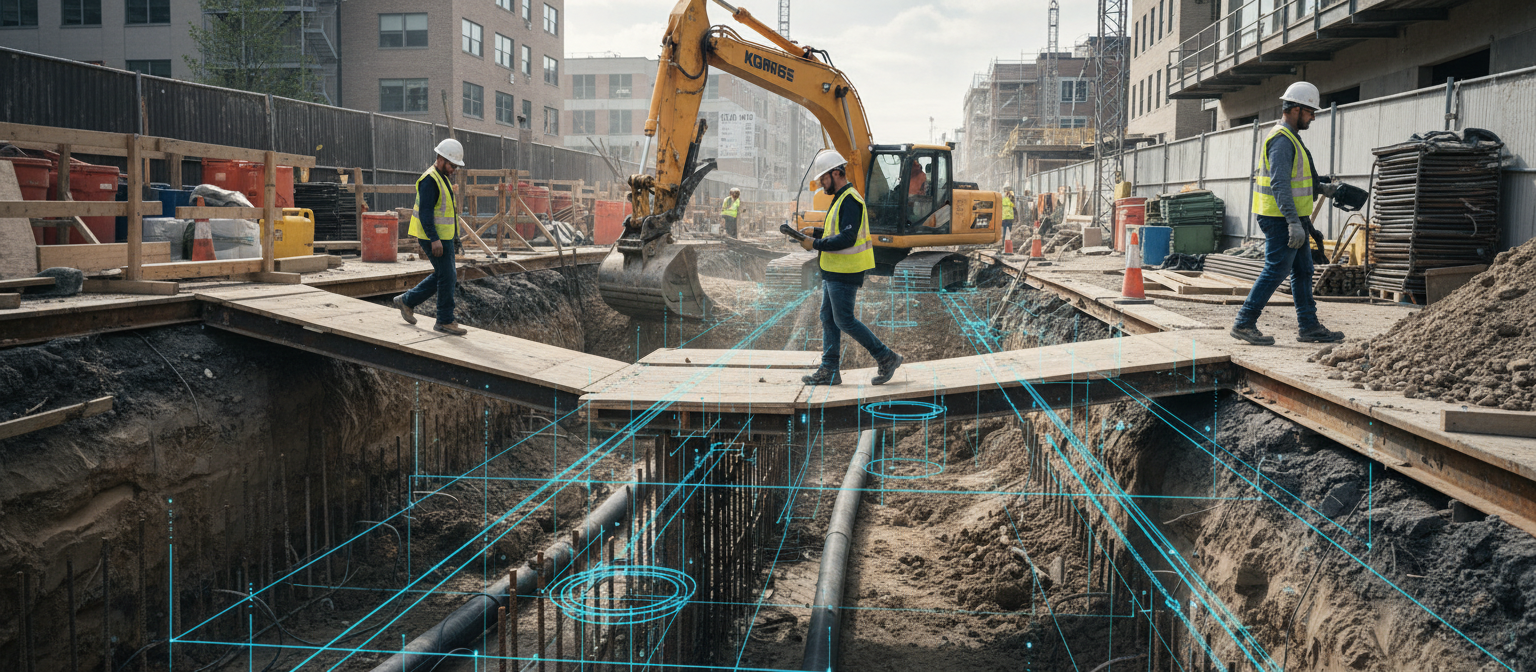
On the construction sites, employees record pipes, shafts and routes themselves using our mobile 3D scanners. The devices deliver high-density point clouds, even when things get hectic or conditions are constantly changing. The aim is not to achieve laboratory precision, but to deliver raw data that can be used directly for planning, comparison with project planning or handover to network operators.
We have found that the main challenge is not the movement, but how to handle the raw data afterwards. If you transfer post-processing to the office, you lose time, money and overview. This is exactly what we want to avoid.
Centimeter accuracy is often completely sufficient
In civil engineering, not every millimeter counts. For routes, shafts and surfaces, a reliable centimeter overview is usually sufficient. It is important that the data is complete, comprehensible and immediately usable. Anything that goes beyond this often only increases effort and costs without bringing any practical advantage.
We therefore make sure that the results are as-built and robust. This allows decisions to be made and planning to be pursued efficiently without unnecessary corrections slowing down the process.
Rework: the hidden cost factor
In many projects, we see the same pattern again and again. Raw data is collected on site and the real work begins back in the office: registering, cleaning, adjusting, setting control points. Weeks later, the data is available, but it costs time, money and nerves. The efficiency of digitization fizzles out and the margin shrinks.
We approach this step differently. For us, post-processing is part of the process right from the start. It is planned, systematic and factored into the price. In this way, we prevent the office work from growing uncontrollably.
Our approach: integration instead of rescue
We rely on a combination of technology and process logic to make the data directly usable:
-
Mobile recording under real conditions: Reliable point clouds and 3D scans are created directly on the construction site, even with movement and changing light conditions.
-
Systematic processing: Semi-automated processing, cleansing and enrichment ensure consistent and quality-assured results.
-
Targeted human-in-the-loop use: Our AI approach is always accompanied by our experts, resulting in a reliable mix of efficiency and quality.
The result is quality-assured as-built data that can be used immediately in planning, GIS or handovers without additional processing.
Economical and plannable
By integrating post-processing into the process, we reduce office work and personnel costs, accelerate project completion and create reproducible results. For us, this means that mobile 3D scans are not only technically possible, but also make economic sense because the data can be used right from the start.
Conclusion
Movement on the construction site is normal. Raw data is raw. The decisive factor is how it is processed and made usable. We rely on structured post-processing, integrated quality control and immediately usable results so that mobile 3D scans and all associated data in civil engineering not only work, but also deliver added value in an economical and practical way.